Inflight Catering for Private Jets, Airlines & Business Aviation
SkyDine provides inflight catering solutions for private jets, commercial airlines, and business aviation worldwide, delivering customized onboard meals coordinated with airports, FBOs, and flight schedules.
What Is Inflight Catering?
Inflight catering is a specialized form of food service designed specifically for aircraft operations. Unlike traditional catering, it must account for altitude, limited onboard equipment, storage constraints, and strict departure timelines.
Meals are prepared with these conditions in mind. Ingredients are selected for stability, packaging is designed for transport and reheating, and every component is organized for efficient use inside the aircraft cabin. The goal is not just to deliver food, but to deliver a complete onboard dining experience that works within the constraints of aviation.


Inflight Catering Across Aviation Segments
Inflight catering is not one size fits all. Different types of aviation require different approaches, and each comes with its own expectations.

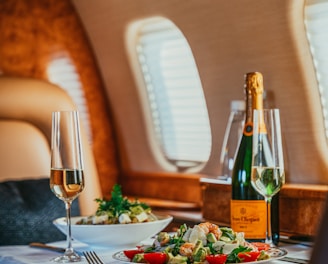
focuses on flexibility and personalization. Orders are often highly customized, reflecting passenger preferences, dietary requirements, and last-minute changes. Presentation matters, but so does practicality, as food must be easy to serve and handle in a compact galley.
Airline & Commercial Inflight Catering
Airline catering operates at a larger scale, where consistency and efficiency are critical. Meals are produced in volume and designed for standardized service across multiple flights, while still maintaining quality and safety.
Executive & VIP Inflight Catering
VIP operations sit somewhere in between. These flights often require elevated menus, premium ingredients, and a balance between customization and operational efficiency.
Crew Meal Inflight Catering
Crew meals are another important part of inflight catering. They need to be reliable, filling, and easy to store and reheat, supporting long duty days and varying schedules.
How Inflight Catering Works
Every inflight catering order begins with flight details. Departure time, airport location, passenger count, and service requirements all shape how the order is built. Aircraft type can also influence the approach, as galley size, storage capacity, and onboard equipment vary and affect how food will be handled during the flight.
Menus are then tailored to match the flight profile. Short-haul trips may require lighter options and quick service items, while longer flights call for more substantial meals and a broader selection. Passenger preferences, dietary requirements, and the timing of service during the flight are also factored in, ensuring that meals are appropriate not just for the route, but for how they will actually be served onboard.
Once prepared, the food is packaged specifically for aviation use. This includes labeling, portioning, and organizing items in a way that allows for smooth onboard service. Packaging is selected for durability, temperature control, and ease of handling, ensuring that meals maintain quality from delivery through service. Timing is critical, and orders are coordinated to arrive at the aircraft through the FBO or ground handler within tight operational windows, often aligned closely with departure schedules.
The final step is delivery and handoff, where accuracy and presentation matter just as much as the food itself. Catering must be ready for immediate use or simple storage, allowing crews to integrate it into service without additional preparation. Clear organization and consistency at this stage help reduce friction during boarding and ensure a smooth transition from ground to inflight service.
Because flight operations are dynamic, this process often requires flexibility. Adjustments for delays, last minute passenger changes, or routing updates are common, and catering must adapt without compromising timing or quality. This is why inflight catering is built around coordination as much as preparation, ensuring that each order aligns with the realities of the flight.


Inflight Catering Coverage Worldwide
Inflight catering is inherently global, as aircraft rarely operate within a single region. Flights move between cities, countries, and continents on tight schedules, requiring catering that can be coordinated consistently across different locations.
SkyDine supports inflight catering throughout the United States, covering both major aviation hubs and regional airports commonly used in private and business aviation. This includes destinations such as Aspen, New York, Seattle, and other key markets where timing and reliability are critical. Across these operations, SkyDine has supported inflight catering at more than 2,800 airports, reflecting the breadth of locations and flight profiles handled.
For international operations, catering needs often extend across Europe, Canada, Mexico, the Middle East, and Asia, where sourcing, standards, and logistics can vary significantly. Coordinating across these regions requires a structured approach, ensuring that each order aligns with local capabilities while maintaining a consistent level of quality.
Rather than treating each location independently, inflight catering is managed as part of a broader network. This allows flights operating across multiple legs or international routes to maintain continuity, with catering that adapts to each stop while remaining consistent for passengers and crew.
Sample Inflight Catering Menus
Inflight catering menus are built around both passenger expectations and operational practicality. Breakfast service might include fresh fruit, pastries, yogurt, and hot options that can be reheated easily onboard. Lunch and dinner selections often feature premium sandwiches, composed salads, and hot entrées adapted for aviation service.
For high end requests, menus can include items such as seafood, steak, or curated small plates, designed to deliver a restaurant quality experience in the air. Snack selections and desserts are equally important, offering a mix of indulgent and lighter options.
Crew meals are typically more straightforward but still require quality and consistency. These might include protein-based dishes, grain bowls, or hot meals that provide energy and hold well during longer flights.
Special dietary requirements are a common part of inflight catering. Meals can be tailored for vegan, gluten-free, dairy-free, or other specific needs, ensuring that every passenger is accommodated.


What to Know When Arranging Inflight Catering
Organizing inflight catering involves more than selecting a menu. Flight timing, aircraft type, and ground handling all play a role in how an order should be structured. Catering must be aligned with departure windows, as access to the aircraft is often limited and tightly scheduled. This makes timing one of the most important factors in the process.
Another consideration is how food will be handled onboard. Storage space, refrigeration, and reheating capabilities vary depending on the aircraft, which affects what types of meals are most suitable. Items that travel well and require minimal adjustment tend to perform best during flight.
Sourcing and availability can also influence menu options, particularly for short-notice requests or flights operating in less central locations. In these cases, flexibility becomes important, as substitutions or simplified menus may be necessary to maintain timing and quality.
By understanding these factors in advance, operators and crews can ensure that catering is not only well-prepared, but also practical for the realities of the flight.
Packaging and Presentation for Inflight Catering
Inflight catering requires a different approach to packaging than traditional food service. Meals need to be organized for limited onboard space, secured for transport, and easy to handle within an aircraft galley. This means containers are selected not just for presentation, but for durability, stackability, and temperature control.
Presentation is still important, particularly for private and VIP flights, but it has to work within operational constraints. Items are often portioned individually, labeled clearly, and arranged so they can be served with minimal preparation. This allows crews to maintain a high standard of service without adding complexity during flight.
Packaging also plays a role in food quality. Meals must retain freshness from delivery through departure and into service, which requires careful consideration of materials, insulation, and how items are stored together. A well-structured order ensures that both presentation and practicality are maintained throughout the flight.


What Foods to Avoid in Inflight Catering
Not all foods work well on an aircraft. Some items can lose quality or become hard to serve once onboard.
Foods that are very delicate or sensitive to moisture can change quickly after delivery. For example, salads with dressing can become soggy, and fried foods like fries or tempura can lose their crisp texture. Soft breads and pastries can also become damp if stored too long. Meals that depend on careful plating, such as stacked dishes or finely arranged items, may not hold their presentation in a small aircraft galley.
Reheating is another factor. Some foods do not heat evenly or can dry out when warmed using onboard equipment. Items like steak can become overcooked, and certain pasta dishes or rice can dry out if not prepared properly for reheating. Foods that require multiple steps, like dishes that need to be assembled or finished before serving, are usually not practical during flight.
Portioning and handling also matter. Foods that spill easily, are messy, or need extra assembly can slow down service and make things harder for the crew. For example, saucy dishes that are not sealed well, build-your-own meals, or large shared platters can be difficult to manage in a limited space.
By avoiding these types of items, meals can stay consistent, easy to handle, and enjoyable throughout the flight.
Why Choose SkyDine For Inflight Catering
SkyDine approaches inflight catering with a focus on execution rather than standard menus. Each order is built around the flight itself, taking into account departure timing, aircraft type, passenger preferences, and how the food will actually be handled onboard. This means meals are not only prepared for quality, but also for practicality, with packaging, labeling, and portioning designed to work inside the constraints of an aircraft cabin.
Coordination is a central part of the process. Orders are aligned with FBO access, ground handling timelines, and crew workflows so that delivery fits seamlessly into the departure window. This reduces last-minute adjustments and ensures that everything is ready for immediate use or organized storage once onboard.
Because no two flights operate the same way, flexibility is built into every step. Whether it is a short notice request, a multi-leg itinerary, or a highly specific passenger preference, SkyDine adapts to the operational reality of the flight while maintaining consistency across different airports and service environments.


Frequently Asked Questions About Inflight Catering
How much does inflight catering cost?
Inflight catering costs vary depending on the number of passengers, the type of menu requested, and how much advance notice is given. Simpler orders for short flights are generally more straightforward, while more customized menus or last minute requests may require additional coordination and sourcing, which can affect overall pricing. For large passenger commercial catering you can expect between $10-26 per passenger depending on volume. For VIP Inflight catering it can get as high as $95-115 per passenger depending on the request. Crew Meal Inflight catering can land in the $20-45 range
How far in advance should inflight catering be ordered?
Advance notice allows for more flexibility in menu selection and sourcing, particularly for more complex or premium requests. However, many inflight catering orders can still be arranged on short notice depending on the location and availability. Keeping menu options flexible often helps ensure that tighter timelines can still be met. Orders can be done in as little as 24 hours or less but 72 hours gives plenty of time to accomplish almost all order requests if possible.
What types of food work best for inflight catering?
Meals that hold temperature well, reheat evenly, and are easy to portion tend to perform best onboard. This is why inflight menus are typically adapted for aviation rather than taken directly from standard restaurant offerings. Practicality and consistency are just as important as presentation.
How is inflight catering delivered to the aircraft?
Inflight catering is usually delivered through an FBO or ground handler rather than a passenger terminal. This allows catering to be coordinated with aircraft access windows and departure timing, ensuring that crews can load and organize everything efficiently before the flight. For commercial flights, they are typically delivered via a high loader but for private flights they are typically delivered to the FBO with the option to be delivered planeside if permission is granted by the FBO (this varies form airport to airport)
What information is needed to place an inflight catering order?
Placing an inflight catering order typically requires key flight details such as departure time, airport, aircraft type, heating element on board, tail number, allergies, passenger count, and any specific menu preferences. Providing this information helps ensure that catering is prepared, packaged, and delivered in a way that aligns with the flight schedule and onboard service requirements. Any additional information needed will be asked by the inflight caterer.
Can you accommodate last minute inflight catering requests?
SkyDine can accommodate last minute inflight catering requests, as many orders are placed within 24 to 48 hours of departure. We have fulfilled orders in the same day all over the world. In these situations, the focus is delivering reliable and well prepared options that can be executed within the available timeframe
Do you offer inflight catering for special dietary requirements?
Yes, inflight catering can be tailored to accommodate a wide range of dietary preferences and restrictions. This includes options such as vegan, vegetarian, gluten-free, dairy-free, and other specific requirements. Menus are adjusted based on passenger needs, with careful consideration for how each item will store, travel, and be served onboard, ensuring both suitability and consistency during flight.
Can inflight catering include beverages and onboard snacks?
Yes, inflight catering can include a full range of beverages and snack options alongside meals. This may include soft drinks, juices, coffee service, and a variety of packaged or prepared snacks such as fruit, nuts, charcuterie, and desserts. Orders can be structured to support different stages of the flight, from pre-departure service to inflight refreshments, depending on passenger preferences and flight duration.